Insights / Search transitions
Changing a Business on the Same Domain: An Evidence-Based SEO Transition Plan
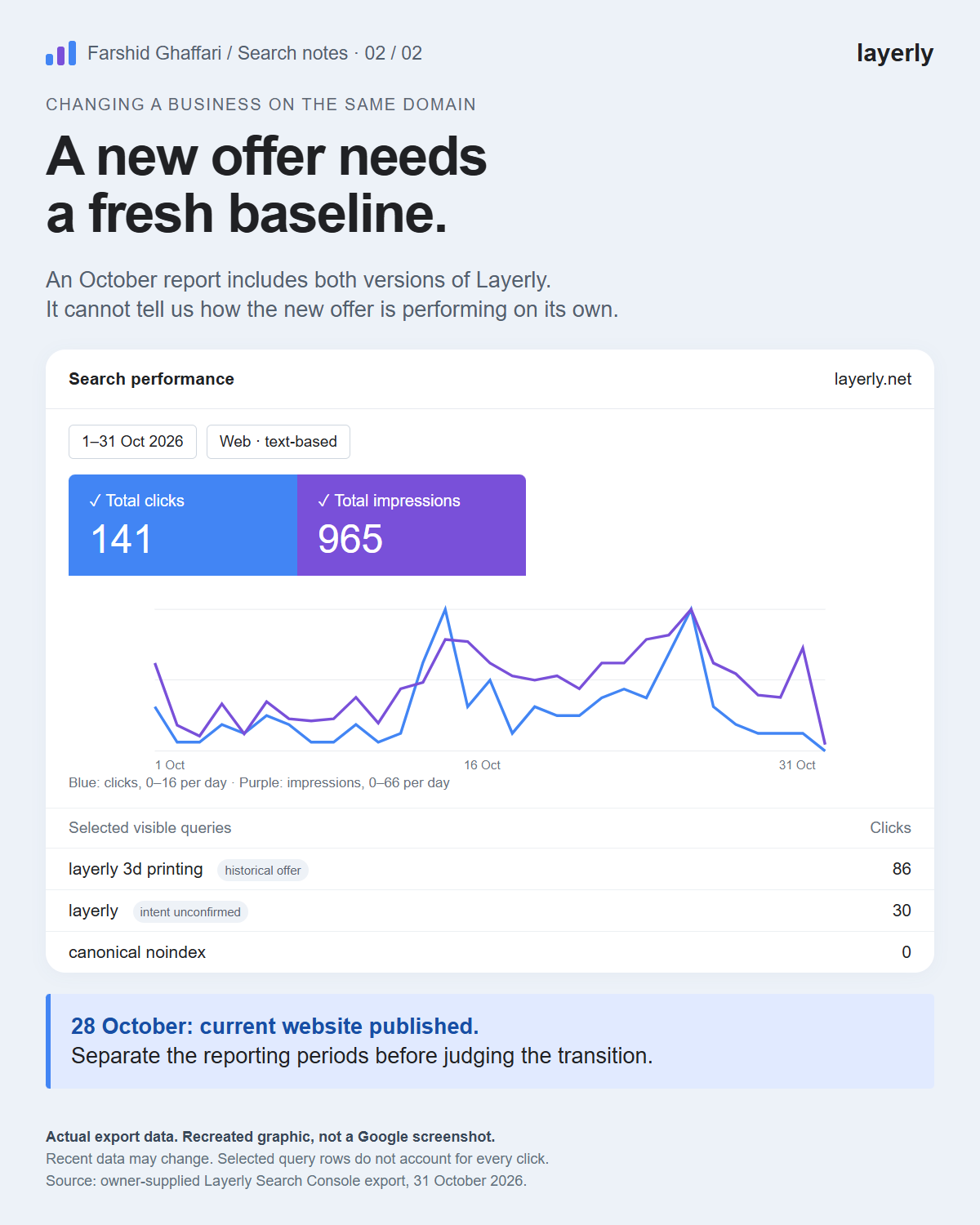
Layerly's October Search Console export records 141 clicks. A single visible query, "layerly 3d printing", accounts for 86. The current SEO and editorial outreach website was published on 28 October 2026.
That combination raises a legitimate business question: when an offer changes substantially, should the domain change too? It does not, on its own, identify a search-engine fault. Most of the reporting period predates the current website. The old-topic clicks could have occurred before publication; the aggregate query table does not tell us when they happened.
This article separates the domain decision, URL handling and measurement design. It uses Layerly as a small observational case, supported by Google documentation. It is an operational analysis, not a controlled experiment, an academic study or evidence that either retaining or replacing the domain has produced better results.
1. Define the change before choosing the remedy
Three situations need different plans. A business can change its offer while retaining its domain and URLs. It can reorganise paths on the same domain. Or it can move to a different domain. These changes can happen together, but they are not interchangeable.
Google's site-move guidance concerns URL changes. Its Change of Address tool is for a move between domains or subdomains, not a business description changing on an unchanged domain. A content pivot alone does not call for that tool. [1]
There is also a separate policy question. Google's expired-domain-abuse policy concerns purchased expired domains repurposed primarily to manipulate rankings with content that provides little value. It is not a blanket prohibition on a business changing its services. This distinction is not a finding about the history or policy status of any specific domain. [2]
For Layerly, the established facts are the current offer, the website publication record and the supplied search export. This article does not claim that a complete backlink-history review, ownership-history investigation or manual-actions inspection has been performed.
2. An existing domain is a business decision, not a ranking guarantee
Before keeping or replacing a domain, assess whether its name still fits the offer, what returning visitors expect, which existing references remain useful and what maintaining a transition would cost. A new domain can separate a new identity, but it also creates a URL-migration project if relevant existing content moves with it.
An old traffic total cannot settle this decision. It describes past search interactions, not the suitability of the name or the future demand for a different service. Nor can it establish how much value any historical links will have for new pages. Google describes ranking systems operating primarily at page level while also using site-wide signals; that is not a promise that a previous topic's performance transfers to a new offer. [3]
Our proposed decision record therefore has four fields: the reason for retaining or changing the name; the evidence reviewed; the unresolved risks; and the observations that would justify revisiting the choice. For Layerly, retaining the domain is the current implementation. Its comparative advantage over starting elsewhere has not been measured.
3. Make a decision for each old URL
A business pivot does not make all historical pages equivalent. Inventory old URLs using available crawl archives, sitemaps, Search Console landing pages and known external references. Then assess what each destination should do for a visitor now.
The following is a proposed decision matrix. The paths are illustrative, not verified historical Layerly URLs.
| Old URL situation | Proposed action | Acceptance evidence |
|---|---|---|
| An article has moved and still answers the same need | Map it to the relevant replacement; use a permanent redirect where the move is permanent | Old URL reaches the intended final page; new page contains the expected material |
| Several old articles have been genuinely consolidated | Assess a redirect to the consolidated resource | The destination materially addresses the source pages' subject |
| A withdrawn service has no relevant replacement | Return an appropriate 404 or 410 when the resource is removed; provide helpful navigation on the error page | The response is genuinely an error and does not pretend an unrelated page replaces the service |
| A historical resource remains useful and will be maintained | Keep it accurate, accessible and clearly distinguished from the current service offer | Visitors can understand its status and reach the current navigation |
On smaller screens, scroll the table horizontally.
Google warns against redirecting many unrelated old URLs to a single destination such as the homepage; those redirects can confuse users and be treated as soft 404s. Its migration guidance also covers removed content without a replacement. [1] Permanent redirects are signals about a resource's move, not a substitute for deciding whether a replacement is relevant. [4]
Do not invent a topical relationship to preserve a superficially attractive metric. A discontinued manufacturing-service page and an SEO-service page are not equivalent simply because the same business controls them. Conversely, deletion should follow an actual content decision, not the desire to eliminate every trace of the previous offer.
4. Distinguish live implementation from Google's recorded version
A revised homepage may be live while search reporting still describes earlier observations. Google explains that updated content takes time to be crawled and indexed. That general behaviour does not prove that a particular site's old-topic traffic comes from stale indexing. [5]
Check the relevant URLs individually. Record the live response, important visible content, indexing directives, declared canonical, internal links and sitemap inclusion. Then inspect Google's indexed information, including its recorded crawl information and selected canonical where available.
Google's URL Inspection documentation distinguishes the indexed report from the live test. The latter assesses the current page's possible indexability; it does not establish that Google has already replaced its indexed interpretation. [6]
Our proposed handover uses two separate checkpoints: implementation verified, and search processing observed. A sitemap submission or successful indexing request belongs to the discovery process, not to a claim that the business has earned rankings for its new service. Google's crawling FAQ explicitly says sitemap inclusion does not guarantee indexing or increase rankings. [5]
5. What the Layerly export establishes
The source is an owner-supplied export for 1 to 31 October 2026, with search type Web (text-based). Summing its daily chart rows gives 141 clicks and 965 impressions.
| Observation | Value | Interpretation limit |
|---|---|---|
| Property click total | 141 | Includes dates before and after the current website publication |
| Clicks for layerly 3d printing | 86 | Explicit historical-topic query; not proof these clicks happened after publication |
| Clicks for layerly | 30 | Brand query with unconfirmed intended service |
| Sum of visible query clicks | 116 | Does not identify all clicks in the property total |
| Clicks unassigned to visible queries | 25 | Arithmetic remainder; not a known category of customers |
| canonical noindex | 0 clicks, 1 impression, average position 87 | Early topic-relevant observation, not a strong ranking result |
On smaller screens, scroll the table horizontally.
The explicit old-topic query accounts for approximately 61% of the recorded property clicks. That is a descriptive proportion, not an estimate of irrelevant visitors or lost revenue. Clicks are not unique people, and the query does not prove a purchase intention.
Google documents that anonymized queries and reporting limits can leave query tables short of chart totals. This export does not identify the exact cause of every omitted click. It would be incorrect to label the remaining 55 clicks after subtracting 86 as new-offer demand: that remainder includes ambiguous brand traffic and unassigned clicks. [7]
The page table has a different complication. Its rows sum to 142 clicks, compared with 141 in the property chart. Google's documentation explains that page and property aggregations differ. We retain the property chart as the stated total and do not add the page rows into a replacement headline. [8]
Separate query and page tables also do not establish a query-to-page pairing. Investigating a specific old-topic query requires a filtered query/page view, not matching similar-looking numbers across independent tables.
6. Define a post-publication window before evaluating the pivot
The deployment record is 28 October 2026 at 16:29:35 UTC. Search Console daily reporting uses Pacific Time. The publication date therefore contains both pre-publication and post-publication observations; it is not a clean full-day baseline. [7]
The export records four clicks and 73 impressions across 29 and 30 October. Those dates are entirely after the website publication, but two days cannot establish a durable trend or the intent behind those clicks. The file was obtained on 31 October, so that current day is excluded from completed-day comparisons. The export itself supplies no explicit finalization certificate for the recent daily rows.
Most importantly, the October query totals are not segmented by publication time. We cannot say that all 86 historical-topic clicks persisted after the pivot, or that Google failed to understand the new site. We also cannot compare this monthly export with an older three-month view and call the difference growth or decline.
For a continuing review, we propose fixed seven-day reporting windows after the launch boundary, using the same search type and classification rules. Compare matching weekday coverage where possible and record incomplete periods separately. This is a review cadence, not a forecast of when the new offer should rank.
7. Build a report that can change the next decision
Keep four query groups: explicit historical-topic queries; ambiguous brand queries; queries related to current services; and clicks that cannot be assigned from the visible query data. Freeze the inclusion rules before comparing periods. If the rules change, recalculate comparable earlier periods or mark the series as changed.
For each group, inspect relevant landing pages using filtered reports. Preserve raw counts, date coverage and extraction dates. A higher proportion of current-service queries might reflect better discovery, a fall in historical demand, or both. Report the component counts before interpreting the proportion.
The proposed transition worksheet links each decision to evidence:
| Decision | Evidence to inspect | Next action if evidence is missing |
|---|---|---|
| An old page has a genuine replacement | Old and new content, destination and observed redirect | Keep the mapping unresolved; do not invent an equivalent destination |
| A new service page can be considered for search | Live response, directives, links and indexed inspection | Investigate the specific access or indexing observation |
| Current-offer search demand is emerging | Comparable query/page reports over defined periods | Collect more comparable observations without attributing historical clicks |
| Traffic supports commercial progress | Stored enquiries, qualified conversations and actual receipts | Report the outcome as unknown rather than deriving sales from clicks |
On smaller screens, scroll the table horizontally.
This framework identifies implementation defects and missing information; it does not isolate the causal effect of the domain choice. Changing content, navigation, measurement and promotion together introduces several plausible explanations for later movement. Search demand and Google's systems can change during the same period. No matched comparison or controlled design has been established here.
8. A defensible conclusion for this stage
The evidence does not show that Layerly's pivot succeeded or failed. It shows a domain with reported demand for a historical offer, a documented publication boundary and a short early window for the current website.
The practical response is to review old destinations, make the current offer clear and measure its discovery separately. Retaining the domain should be evaluated against those observations and the business's identity requirements, rather than defended with a headline traffic total.
A stronger later case study will show the original URL decisions, dated implementation checks, comparable search observations and any verified commercial outcomes. Until those exist, the useful contribution is a transparent transition method with an explicit account of what remains unknown.
Sources and case provenance
[1] Google Search Central: How to move a site. Applied here only where URL handling or an actual address change is involved.
https://developers.google.com/search/docs/crawling-indexing/site-move-with-url-changes
[2] Google Search Central: Spam policies, expired domain abuse.
https://developers.google.com/search/docs/essentials/spam-policies#expired-domain-abuse
[3] Google Search Central: A guide to Search ranking systems.
https://developers.google.com/search/docs/appearance/ranking-systems-guide
[4] Google Search Central: Redirects and Google Search.
https://developers.google.com/search/docs/crawling-indexing/301-redirects
[5] Google Search Central: Crawling and indexing FAQ.
https://developers.google.com/search/help/crawling-index-faq
[6] Google Search Console: URL Inspection tool.
https://support.google.com/webmasters/answer/9012289?hl=en
[7] Google Search Console: Troubleshooting data discrepancies.
https://support.google.com/webmasters/answer/17010575?hl=en
[8] Google Search Console: Performance report overview and setup.
https://support.google.com/webmasters/answer/7576553?hl=en
Sources reviewed: 1 November 2026. Google documents platform behaviour; the decision matrix, reporting groups and review cadence are proposed Layerly working methods.
Case evidence: Layerly Search Console export supplied 31 October 2026, date filter 1 to 31 October 2026. Source ZIP SHA-256: e0514616933bc6bae5ce19f08cd4743d18240eaab058b134fda8ee3cf17f9c42. Current-site deployment verified at 2026-10-28T16:29:35Z.
Sources and provenance
- Google: URL moves and migrations
- Google: expired domain abuse
- Google: search ranking systems
- Google: redirects
- Google: crawling and indexing FAQ
- Google: URL Inspection
- Google: reporting discrepancies
- Google: performance report setup
Sources reviewed 1 November 2026. Google documents platform behaviour. The decision matrix, classification groups and review cadence are Layerly proposals. The evidence is one observational case, not a controlled experiment or a measured client result.
Case source: owner-supplied Search Console export for 1 to 31 October 2026, Web (text-based). ZIP SHA-256: e0514616933bc6bae5ce19f08cd4743d18240eaab058b134fda8ee3cf17f9c42. Current-site publication: 28 October 2026, 16:29:35 UTC.